Do GLP-1 Gummies, Patches and Drops Actually Work? An Honest Review
GLP-1 gummies, patches, and drops are everywhere — but none of them contains actual GLP-1. Here's what the evidence says about what's really inside them, why the delivery format can't work, and what food can honestly do instead.
No. No gummy, patch, or drop contains actual GLP-1 — the hormone is a large peptide that can't pass through skin or survive stomach acid, and no such product is FDA-approved. Some ingredients may modestly support appetite or blood sugar, but nothing over the counter comes close to prescription GLP-1 results. Food-first fiber is the honest alternative.
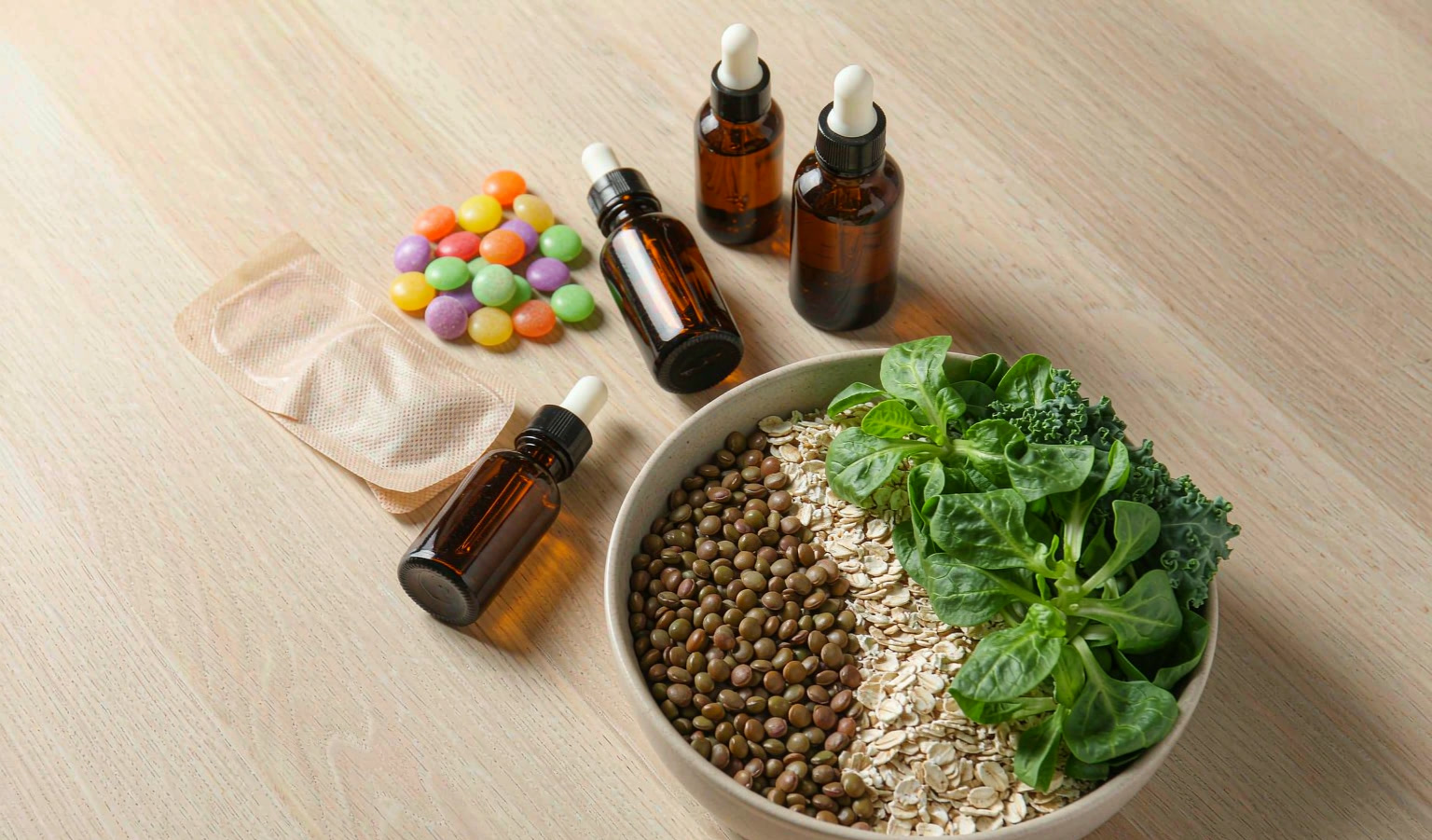
Walk into any supplement aisle or scroll any feed and you'll find them: gummies, patches, and drops promising GLP-1 results without the prescription, the needle, or the price tag. A recent Sunday World piece put the question bluntly — are these products 'miracle alternatives or snake oil?' It's the right question, and mainstream media has asked it before. Oprah Daily asked the same thing in October 2026 — do natural GLP-1 supplements work?
The timing isn't an accident. About 12% of adults in the US said they were taking a GLP-1 drug in late 2025, double the share 18 months earlier, according to KFF. And the supplement industry has rushed to meet the demand: mentions of GLP-1 in supplement launches grew 67% between July 2023 and June 2026, according to Innova Market Insights. Where there's a famous drug and a long waiting list, there's a shelf full of shortcuts.
This post is the honest answer. Not a takedown of everyone who buys these products — the appeal is completely understandable — but a look at what they are, what they aren't, and what works instead.
First, What GLP-1 Actually Is
GLP-1 is a hormone your gut makes naturally after you eat. It helps with insulin release, slows stomach emptying, and signals fullness to your brain. The prescription drugs semaglutide and tirzepatide mimic that hormone — but they are engineered to last. Your body's own GLP-1 is broken down within one to two minutes by an enzyme called DPP-4. Semaglutide, by contrast, has a half-life of about a week. That durability gap is the whole ballgame, and no food or supplement closes it.
The delivery format matters just as much. GLP-1 is a large peptide molecule — too big to pass through skin, gums, or the lining of your nose, according to Science-Based Medicine. That is why no patch, gummy, drop, or nasal spray delivers a real GLP-1. The only needle-free GLP-1 medicines that exist are three FDA-approved oral tablets — Rybelsus and oral Wegovy (both semaglutide) and Foundayo (orforglipron) — and even those required years of pharmaceutical engineering to survive digestion. We covered what daily oral dosing means for your gut in our guide to oral GLP-1 pills.
So when a product calls itself a 'GLP-1 gummy' or a 'GLP-1 patch,' the name is doing the work. The product itself is something else entirely.
Gummies: What's Actually Inside Them
A 'GLP-1 gummy' contains no GLP-1. What it usually contains is a blend of familiar supplement ingredients — berberine, fiber, probiotics, chromium, or green tea extract — in a sweet, chewable form. Some of these ingredients have modest evidence behind them. The problem is the size of the effect, and the size of the promise.
Take berberine, the ingredient most often crowned 'nature's GLP-1 drug.' A 2026 meta-analysis of 23 studies found it beat control by 0.88 kg on average — under two pounds — and a six-month double-blind trial in 337 adults found no difference at all. Fiber, probiotics, chromium, and green tea extract tell a similar story: across independent meta-analyses, the average difference from placebo runs from 0.04 to 0.60 kg — a fraction of a pound to about a pound and a half, with several results not statistically significant.
Now compare that with the drug these products borrow their name from. In the STEP 1 trial published in the New England Journal of Medicine, semaglutide 2.4 mg reduced body weight by 14.9% over 68 weeks, versus 2.4% with placebo. For a 200-pound person, that's roughly 30 pounds versus 5. A gummy delivering under two pounds against a drug delivering thirty is not a 'natural alternative.' It's a different category of thing wearing the drug's name.
None of this means the ingredients are useless. Fiber supports digestion and satiety; berberine has real research behind it for blood sugar. But the honest way to describe them is 'ingredients with small, real effects' — not 'GLP-1 in a gummy.'
Patches and Drops: Why the Format Can't Work
If gummies are a naming problem, patches and drops are a physics problem. A patch is supposed to deliver its active ingredient through the skin. But as noted above, the GLP-1 peptide is far too large to cross the skin barrier — pharmaceutical companies have tried for decades to build a GLP-1 patch and none has succeeded. Drops and sprays claim the drug slips in under the tongue or through the nose; the same size problem applies, and there is no published evidence that they deliver a therapeutic dose.
What these products usually contain is a mix of stimulants like caffeine, herbal extracts, or flavored water — ingredients with no GLP-1 activity. Some are simply placebos. Worse, the category has attracted outright fraud: the FDA has sent warning letters over products sold as 'GLP-1' drops and a 'GLP-1' patch, classifying them as unapproved drugs. And 'all-natural' weight-loss products have repeatedly been found to hide sibutramine, a drug removed from the US market in 2010 over heart risks.
Red flags worth memorizing: a promise of drug-like results in weeks, a price of $20–$50 for something the real drug costs hundreds for, no FDA approval number, and sales only through social media or unverified websites. Any one of those is enough to walk away.
The Honest Middle: What Food Can Actually Do
Here's where the conversation usually goes wrong — it splits into two camps that are both incorrect. One side says food can replace the drug. The other says food does nothing. The truth is in the middle, and it's actually good news.
Dietitian Salena Sainz, author of 'The Natural GLP-1 Revolution,' put it more honestly than her own book title. In a November 2026 interview, she said: 'You won't get the drug's powerful effect from food. You'll feel better, and that's it.' Her advice is refreshingly ordinary: protein stimulates GLP-1 release more strongly than any other macronutrient — eggs, fish, legumes, soy. And when beneficial gut bacteria ferment certain fibers, they produce substances like butyrate, which can stimulate the satiety hormone. Her list includes oats, vegetables, beans, whole fruit, seeds — and cooked-then-cooled rice or potatoes, which contain resistant starch.
That fiber-to-butyrate pathway is real, and it's the mechanism we keep coming back to. When resistant starch reaches your colon, your gut bacteria ferment it into short-chain fatty acids, including butyrate. In one study published in Gut, delivering a related short-chain fatty acid directly to the colon reduced food intake. And a 2018 study found that a resistant-starch meal raised post-meal GLP-1 in step with acetate, another fermentation product. The effect is genuine — and it is modest, gradual, and supportive rather than pharmaceutical. We explain the full pathway in our resistant starch guide, and our resistant starch foods list shows where to find it on an ordinary plate.
The supplement industry itself is starting to say this out loud. At CPHI Milan 2026, ingredient suppliers warned that the GLP-1 companion category risks a credibility gap without evidence. Roquette's Elodie Dehay Harmel put it plainly: 'Not all fibers or proteins are equal... Ingredients need to demonstrate efficacy for targeted outcomes, such as muscle maintenance, satiety, or digestive health, through appropriate studies.' Probi's Brandy Webb added that a true companion ingredient 'should address side effects, not just add generic benefit.' And in a companion report, suppliers including Beneo and Saanroo urged the industry to position nutrition as a complement to GLP-1 drugs, not a competitor — because 'supplements can never be equivalent to pharmaceuticals, but can support the safe and effective use of GLP-1 medications.'
That word — complement — is the honest frame. With up to half of GLP-1 users stopping the medication within a year, and research cited at CPHI putting the lean-mass share of semaglutide weight loss at around 40%, there is a real job for nutrition alongside the drug: protecting muscle with protein, feeding the gut with fiber, and keeping appetite signals steady. That's the job food can do. Pretending it can do the drug's job is what breaks trust.
How to Judge Any Natural GLP-1 Product
Before you buy anything with GLP-1 on the label, run it through four questions:
- 1. Does it claim to contain GLP-1? If yes, it's false on its face. No over-the-counter product contains the hormone.
- 2. Does it promise drug-like weight loss? 'Lose 15 pounds in a month' or 'GLP-1 results without the shot' is a marketing claim, not a scientific one. Compare the promised number with the evidence — under two pounds for berberine, fractions of a pound for most other ingredients.
- 3. Does it name a mechanism, a dose, and human evidence? A credible product tells you what it does, how much of the ingredient you get, and what study supports it. 'Proprietary blend' with no amounts and no citations is a dodge.
- 4. Is it a companion or a replacement? Products that help you eat well alongside medication — or support your gut while you work on habits — are doing honest work. Products that tell you to skip the doctor are not.
If a product passes all four, it might be a reasonable purchase. Most of the gummies, patches, and drops on the market fail the first question.
The Food-First Option
None of this means you're out of options if the drug isn't for you — or if you're between prescriptions, or simply prefer to start with food. It means the options that work look different from the ads. A plate built around protein and fiber, vegetables before bread, a short walk after meals, dinner a couple of hours before bed: Sainz's own advice reads like something your grandmother would recognize, and that is exactly the point. The habits are old. Only the label is new.
Resistant starch is the most practical piece of that plate, because it's the easiest to add without changing how you eat. Green bananas, oats, lentils, and cooled rice or potatoes all deliver it — the food-first route stays the same. Our own product is built for the same routine: GLP-1 Support* Capsules — a gut-first, plant-powered daily capsule with botanicals (hops, lemon, green tea), an 8-strain probiotic blend, and B-vitamins in a 30-in-1 formula. Three capsules with breakfast, no mixing. Contains no GLP-1 or semaglutide — and it is not a fiber supplement; the fiber still has to come from food. Our guide to why fiber matters more when you eat less explains why that small daily habit carries outsized weight when appetite is low.
So: miracle or snake oil? The gummies, patches, and drops are neither miracle nor medicine. They are ordinary ingredients in extraordinary packaging, sold on a borrowed name. The honest alternative was never on that shelf. It's on your plate — and in the small daily habits that support the gut you've already got.
References
- Sunday World (November 2026). 'GLP-1 gummies, patches and drops — miracle alternatives or snake oil?'
- Oprah Daily (October 30, 2026). 'Do Natural GLP-1 Supplements Work? 60 Weeks Into the GLP-1 Revolution — Now What?'
- Metla.mk (November 1, 2026). 'There's No Natural GLP-1: Dietitian Salena Sainz Says Food Can't Catch the Drug, but Protein, Fiber and a Ten-Minute Walk Can Boost the GLP-1 Hormone.'
- Nutrition Insight (October 2026). 'Suppliers warn GLP-1 companion category risks credibility gap without evidence.'
- Nutrition Insight (October 2026). 'GLP-1 companion nutrition must complement drugs, not compete, suppliers urge.'
- Nutrition Insight (October 2026). 'Protein, fiber & taste drive next wave of GLP-1 companion nutrition.'
- GLP Chart (August 27, 2026). 'Are GLP-1 patches gummies and drops real? No.'
- Saciedad.com (2026). 'GLP-1 Supplements and Natural GLP-1: What the Evidence Says.'
- Wilding, J. P. H. et al. (2021). Once-weekly semaglutide in adults with overweight or obesity. New England Journal of Medicine, 384, 989–1002. (STEP 1 trial: 14.9% vs. 2.4% weight loss over 68 weeks.)
- Chambers, E. S. et al. (2015). Effects of targeted delivery of propionate to the human colon on appetite regulation, body weight maintenance and adiposity. Gut, 64(11), 1744–1754.
This article is for educational purposes only and is not medical advice. If you are considering GLP-1 medication, changing your medication, or starting any new supplement, please talk to your doctor first.
Frequently Asked Questions
Is there any supplement that actually contains GLP-1?
Do natural GLP-1 gummies help with appetite at all?
Why can't a GLP-1 patch work?
What can food honestly do for natural GLP-1?
Keep Reading
What “GLP-1 Friendly” on a Food Label Actually Means (and Doesn’t)
Grocery aisles are filling up with “GLP-1 friendly” foods. Food Dive calls the label a problem and Women’s Health is asking what it even means — so we read the fine print. Here’s how to tell a thoughtfully made product from a marketing sticker, in about ten seconds per label.
Read article →
The #1 Food for Gut Health Isn't a Fruit or Vegetable — It's Beans
EatingWell asked the experts and the answer wasn't kale, berries, or yogurt — it was beans. Here's why beans quietly outperform almost every other gut-health food, and how to eat more of them without the bloating that scares people off.
Read article →