Why Fiber Matters More When You Eat Less
Eating less is the point of GLP-1 treatment — but nobody warns you that fiber is the first nutrient to quietly disappear. Here's the math of the fiber gap, why each gram works harder on a smaller appetite, and how to close the gap without feeling stuffed.
When GLP-1 medication cuts how much you eat, fiber intake falls with it — and most people were already below target. Smaller meals mean less fuel for gut bacteria and a higher constipation risk. So fiber density per bite matters more than ever: fiber-rich, small-volume foods keep your microbes fed and appetite signals steady on far less food.
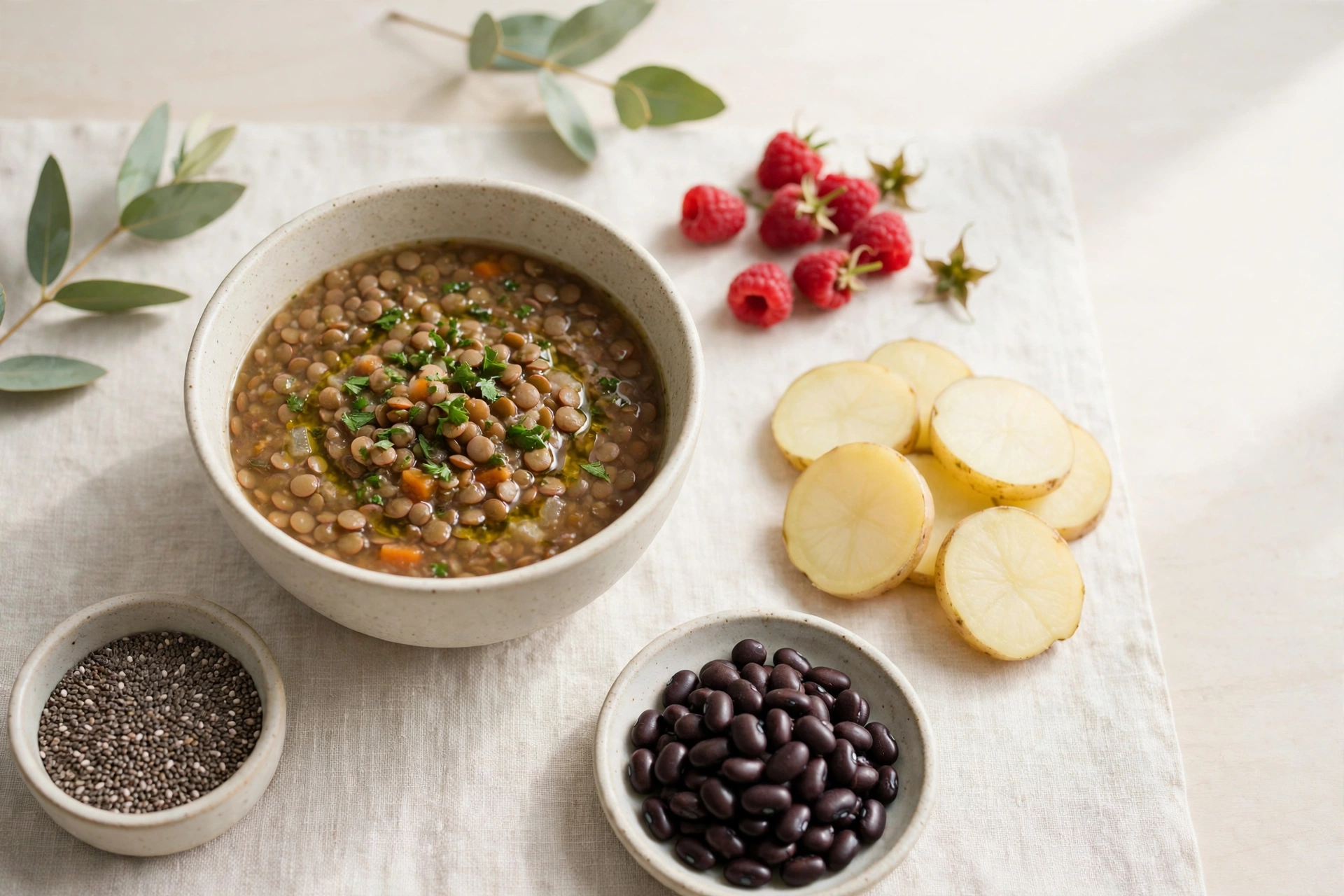
Nobody starts a GLP-1 medication planning to eat less fiber. It just happens. Appetite drops, portions shrink, meals get skipped — and the foods that quietly fall off the plate first are the bulky, fibrous ones: the big salads, the beans, the fruit you'd have eaten out of habit. What's left tends to be small, protein-focused, and easy to finish.
That trade sounds harmless. It isn't. Fiber is the one nutrient your gut bacteria actually eat, and when your total food intake drops by a third or more, your fiber intake usually falls even further. This article is about that hidden gap: why it widens on GLP-1 therapy, why every gram of fiber does more work when you eat less, and how to close the gap in portions your stomach can actually handle.
The math problem: fiber scales with food — until it doesn't
Fiber recommendations aren't a fixed number. The Dietary Guidelines benchmark is 14 grams of fiber per 1,000 calories eaten. Eat 2,200 calories and the target is roughly 31 grams. Eat 1,400 calories — a realistic intake for many people on GLP-1 therapy — and the proportional target drops to about 20 grams.
Two problems follow. First, most people weren't hitting the target to begin with: average US fiber intake is only about 16 grams a day, and roughly 5% of adults meet the recommended amount. Second, the drop in fiber is usually worse than the drop in calories. In clinical trials, semaglutide cut free-eating energy intake by about 35% at test meals — and when people eat less overall, they protect protein (correctly, for muscle) and let fiber slide. The result is a double squeeze: a smaller target you're still not reaching, on top of a gut that's getting far less of the one thing its microbes run on.
If you're eating noticeably less on a GLP-1 medication and wondering whether it matters — this is the specific way it matters most.
Why each gram of fiber works harder on a smaller appetite
It feeds the signaling system the medication is borrowing. Your gut bacteria ferment fiber into short-chain fatty acids, including butyrate. Those fatty acids stimulate your intestinal L-cells to release GLP-1 — your body's own version of the signal these drugs amplify. Research on this pathway (Tolhurst et al., Diabetes, 2012) showed short-chain fatty acids directly trigger GLP-1 secretion. When you eat less fiber, you underfeed that native signaling system at exactly the moment you're relying on appetite signals to stay stable.
It keeps things moving in a gut that's been slowed down. GLP-1 medications slow gastric emptying and gut motility — that's part of how they work. The trade-off is that constipation is one of the most common complaints during therapy. Fiber adds bulk and holds water in the stool, which is the standard first-line dietary counterweight to a slower gut. Less food in, less bulk out — unless fiber density goes up.
It smooths out smaller, denser meals. Eating less often means eating more calorie-dense food per bite. Viscous fiber slows digestion and blunts the glucose rise after a meal, which steadies the energy dips that can retrigger food noise between meals.
It delivers satiety per bite, not per plate. When your stomach genuinely can't hold a large volume, fullness has to come from composition instead of quantity. Fiber-rich foods trigger stretch and hormonal fullness signals out of proportion to their size — the closest thing to a free lunch a small appetite gets.
The density rule: judge food by fiber per bite
The fix is not “eat more.” You can't — that's the medication working as intended. The fix is choosing foods where fiber is concentrated in a small volume:
- Lentils, cooked — 1 cup ≈ 15.6 g fiber
- Black beans, cooked — 1 cup ≈ 15 g
- Chia seeds — 1 oz (about 2 tbsp) ≈ 10 g
- Raspberries — 1 cup ≈ 8 g
- Pear, with skin — 1 medium ≈ 5.5 g
- Broccoli, cooked — 1 cup ≈ 5 g
- Oats, dry — ½ cup ≈ 4 g
Half a cup of lentil soup can carry more fiber than the large salad you no longer have room for. That's the whole game now: density over volume.
One category deserves a special mention because it was almost designed for this problem: resistant starch. It's a fermentable fiber found in cooked-and-cooled rice, potatoes, and pasta, green bananas, and legumes — and it reaches your colon intact, where bacteria ferment it into those same short-chain fatty acids. In one controlled trial in healthy adults, resistant starch at breakfast and lunch was associated with 7–10% lower calorie intake later in the day (Bodinham et al., British Journal of Nutrition, 2010). It delivers microbial payoff in a few spoonfuls rather than a full plate, which is precisely what a reduced appetite needs. (New to it? Start with what resistant starch is and how much resistant starch supports natural GLP-1.)
How to add fiber back — without the bloat
The fastest way to feel worse on a GLP-1 is to double your fiber overnight. Go gently:
- Ramp by about 5 grams per week. Your bacteria need time to adjust their fermentation capacity; a sudden jump is the classic cause of new gas and bloating.
- Pair fiber with water. Fiber absorbs water as it moves through the gut. Adding fiber while under-drinking — common when appetite and thirst cues are both dialed down — can make constipation worse, not better.
- Spread it across the day. Three small fiber moments (chia in a morning smoothie, lentils at lunch, berries after dinner) sit far better than one giant fiber bomb.
- Use the cooled-starch trick. Cook rice, potatoes, or pasta, chill them overnight, and eat or gently reheat the next day. Cooling converts some of the starch into the resistant form — more fiber value from the same small portion.
- Don't neglect fermented foods. Fiber feeds the bacteria you have; fermented foods like yogurt and kefir add live ones. On a smaller diet, the two strategies cover for each other. (If bloating is already your main issue, our guide to bloating and prebiotics goes deeper.)
What does that look like across a real day of small meals? A compact smoothie with 2 tablespoons of chia and a handful of raspberries in the morning (~13 g). A cup of lentil soup at lunch (~15 g) — or half a cup (~8 g) on a low-appetite day. A cooled potato or a small bean salad next to your dinner protein (~5–7 g). Berries after dinner (~4–8 g). That's roughly 25–35 grams of fiber without a single plate that feels like a challenge — no supplement-aisle marathon, no giant salad. Same foods you already like, chosen denser and timed smaller.
The bottom line
Eating less changes the math on everything, but fiber most of all — because it was scarce before the appetite dropped, it falls faster than calories do, and the gut depends on it for signaling, regularity, and microbial fuel. You don't need to eat more to fix it. You need each bite to carry more: denser fiber sources, cooled resistant starches, a slow ramp, and enough water to let the fiber do its job.
Get that right, and a smaller appetite stops being a nutritional liability — it becomes a more efficient way to feed the gut that's been running your appetite signals all along. And if you're protecting muscle during therapy (you should be), fiber is the natural partner to the protein strategy we cover in losing muscle on GLP-1.
References
- U.S. Department of Agriculture & U.S. Department of Health and Human Services. Dietary Guidelines for Americans, 2020–2025. Fiber adequate intake benchmark: 14 g per 1,000 kcal.
- Quagliani, D. & Felt-Gunderson, P. Closing America's Fiber Intake Gap. American Journal of Lifestyle Medicine, 2017 — average US intake ~16 g/day; only ~5% of adults meet the adequate intake.
- Blundell, J. et al. Effects of once-weekly semaglutide on appetite, energy intake, control of eating, food preference and body weight in subjects with obesity. Diabetes, Obesity and Metabolism, 2017 — ad libitum energy intake reduced by ~35%.
- Tolhurst, G. et al. Short-chain fatty acids stimulate glucagon-like peptide-1 secretion via the G-protein-coupled receptor FFAR2. Diabetes, 2012 — the fiber → SCFA → natural GLP-1 pathway.
- Bodinham, C.L., Frost, G.S. & Robertson, M.D. Acute ingestion of resistant starch reduces food intake in healthy adults. British Journal of Nutrition, 2010 (PMID: 19857367) — 7–10% lower subsequent energy intake in healthy adults.
Frequently Asked Questions
How much fiber should I get on a GLP-1 medication?
Why am I constipated on a GLP-1 medication, and does fiber actually help?
What are the best fiber foods when I have almost no appetite?
Can I just take a fiber supplement instead?
Is a fiber-focused diet the same as taking a GLP-1 medication?
Keep Reading
What “GLP-1 Friendly” on a Food Label Actually Means (and Doesn’t)
Grocery aisles are filling up with “GLP-1 friendly” foods. Food Dive calls the label a problem and Women’s Health is asking what it even means — so we read the fine print. Here’s how to tell a thoughtfully made product from a marketing sticker, in about ten seconds per label.
Read article →
The #1 Food for Gut Health Isn't a Fruit or Vegetable — It's Beans
EatingWell asked the experts and the answer wasn't kale, berries, or yogurt — it was beans. Here's why beans quietly outperform almost every other gut-health food, and how to eat more of them without the bloating that scares people off.
Read article →