Kimchi and Gut Health: What the $760M Fermented Food Boom Gets Right
Kimchi just got the U.S. government's official gut-health nod — the first time ever. Here's what the $760 million boom actually means for your microbiome, what kimchi can and can't do, and where it fits next to fiber.
Kimchi is having an American moment: the 2025–2030 U.S. Dietary Guidelines named it for the first time as a fermented food that supports a diverse gut microbiome. U.S. kimchi sales hit $760 million in 2025. Its live Lactobacillus cultures support microbial diversity, but kimchi complements fiber — it doesn't replace it. The GLP-1 satiety pathway runs on fiber fermentation.
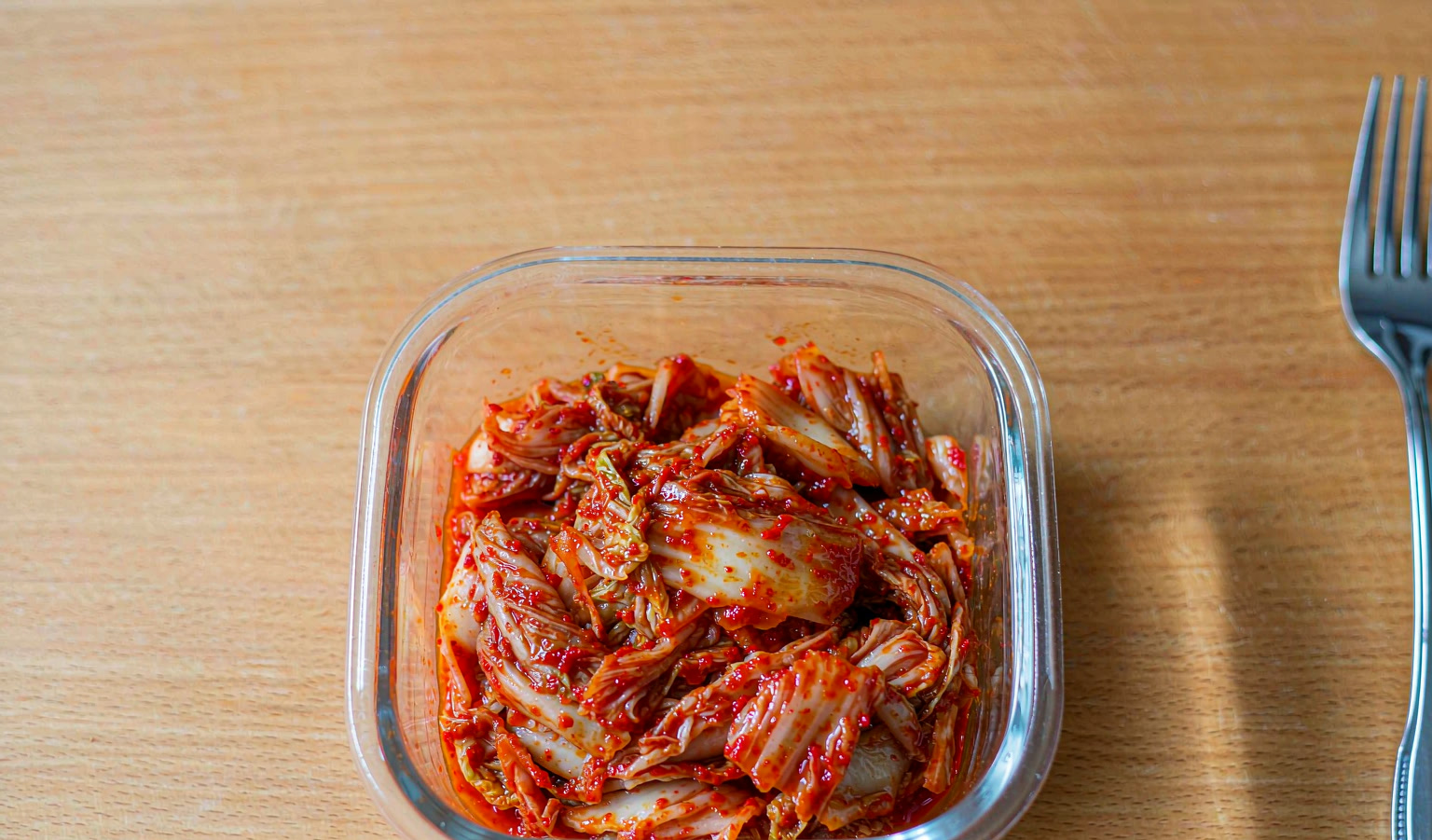
Kimchi has crossed over. What was once a Korean staple found only in Asian groceries is now a refrigerated-aisle regular at Costco and Whole Foods — and in January 2026, the U.S. Dietary Guidelines for Americans 2025–2030 named kimchi for the first time ever as a fermented food that can support a diverse gut microbiome. The U.S. kimchi market hit an estimated $760 million in 2025, Korean exports just posted a record $164.4 million year, and Pulmuone reported its U.S. kimchi sales up 12.3% in the first half of 2026.
The hype is real. The question is what the hype is actually about — and where kimchi honestly fits in a gut-health strategy built on fiber. Here's the clear-eyed version.
Why Is Kimchi Everywhere Right Now?
Short answer: three forces collided — a government endorsement, a retail explosion, and a genuine consumer shift toward gut-health foods.
The endorsement. The Dietary Guidelines for Americans 2025–2030, issued by the Departments of Health and Human Services and Agriculture, grouped kimchi with sauerkraut, kefir, and miso as fermented-food examples supporting a diverse gut microbiome (reported by Korea JoongAng Daily, July 2026). These guidelines set the framework for federal school meals and nutrition assistance programs — so this isn't a wellness-blog claim, it's federal nutrition policy.
The retail explosion. Korea shipped $164.4 million of kimchi last year — a record — to 102 countries, the first time that number hit triple digits (Korea Customs Service data). In the U.S., Korean restaurant counts nearly doubled from 4,200 in 2020 to 7,800 by 2026, putting kimchi in front of millions of new eaters as a menu staple. Local U.S. production is scaling too, which means fresher product and lower prices.
The consumer shift. Market research cited by Dataintelo found that 67% of North American kimchi consumers now cite health benefits as their primary purchase motivation — up from 38% just three years ago. More than 19 million Americans consume fermented vegetables regularly, and roughly 28% actively seek probiotic-rich foods. People aren't buying kimchi as an exotic condiment anymore; they're buying it as functional food.
That's the boom. Now the biology.
What Does Kimchi Actually Do for Your Gut?
Short answer: kimchi delivers live Lactobacillus bacteria and microbial diversity — the 'seed' side of gut health. It does not deliver fiber — the 'fertilizer' side — and the two jobs are different.
Kimchi is cabbage (usually napa) and radish salted, seasoned, and left to ferment. During fermentation, lactic acid bacteria — primarily Lactobacillus and Leuconostoc species — multiply into the billions per serving. When you eat unpasteurized, refrigerated kimchi, you're ingesting those live cultures.
What the cultures plausibly do:
- Add diversity. A more diverse microbiome is consistently associated with better gut resilience. Fermented foods are one of the few dietary levers with direct human evidence for increasing diversity (more below).
- Contribute transient probiotics. Most kimchi bacteria don't permanently colonize your colon — they pass through, interacting with your resident microbes and immune tissue along the way. 'Transient' doesn't mean useless; the interaction itself appears to matter.
- Deliver fermentation byproducts. Kimchi contains organic acids, small amounts of bioactive peptides, and polyphenols from its chili, garlic, and ginger — compounds with antioxidant activity independent of the live bacteria.
What kimchi does not do: feed your butyrate factory. Kimchi is low in the fermentable fiber that your colon bacteria turn into butyrate and other short-chain fatty acids — the molecules that activate your natural GLP-1 satiety pathway. (That's fiber's job; see our breakdown of how much resistant starch supports natural GLP-1.)
The one-sentence version: kimchi seeds the garden; fiber fertilizes it. You want both.
What Does the Research Actually Show?
Short answer: the strongest human evidence is for fermented foods as a category — a landmark Stanford trial showed they increase microbiome diversity and calm inflammation. Kimchi-specific trials exist but are smaller; the honest case for kimchi rests on the category evidence plus its documented microbial content.
Study 1 — Fermented foods increased microbiome diversity and lowered inflammation (Cell, 2021). In a 17-week randomized trial at Stanford, Wastyk and colleagues assigned adults to a diet high in fermented foods (yogurt, kefir, kimchi, kombucha, sauerkraut) or high in fiber. The fermented-food group increased gut microbiome diversity and decreased 19 inflammatory markers — a striking result, since diversity is notoriously hard to move with diet. (The high-fiber group, interestingly, didn't gain diversity but did increase microbiome function — more evidence that fiber and fermented foods do different jobs.)
Study 2 — The federal nod (Dietary Guidelines for Americans 2025–2030). When the U.S. government names a specific food as supporting a diverse gut microbiome, it's working from the accumulated literature, not a single trial. The guidelines' fermented-food grouping — kimchi alongside kefir, sauerkraut, and miso — reflects the category-level evidence from trials like Stanford's.
Study 3 — The consumer reality check. That 67%-cite-health-benefits figure (Dataintelo) matters for a different reason: it tells you the boom is demand-driven by wellness intent, not just K-culture fandom. When two-thirds of buyers are buying for gut health, the category gets R&D investment — lower-sodium versions, vegan formulations, prebiotic-fortified kimchi — which is already happening.
The honest summary: no single food 'fixes' a microbiome, kimchi included. But as a daily, affordable source of live cultures with category-level trial backing and a federal endorsement, it's one of the most evidence-supported additions to a gut-health routine — alongside fiber, not instead of it.
Kimchi vs. Fiber: The Honest Hierarchy
This is where most kimchi content goes wrong — pitching it as a gut-health complete solution. Here's the hierarchy we use across this blog:
- Fiber first (the fertilizer). Fermentable fiber — resistant starch, beans, oats, lentils — is what your resident bacteria convert into butyrate and the GLP-1 satiety signal. Nothing else does this job. (Our full ranking: the complete list of resistant starch foods; the dosing picture: how much resistant starch you need for the GLP-1 effect.)
- Fermented foods second (the seed). Kimchi, kefir, yogurt, sauerkraut add live cultures and diversity. The Stanford trial suggests this is a genuinely independent lever.
- Variety over volume. The '30 plants a week' instinct from the #fibremaxxing trend applies here too — different fermented foods carry different cultures.
If you do one thing: keep your fiber habit and add a forkful of kimchi to a meal you already eat. That's the whole strategy.
A Practical Kimchi Buying and Eating Guide
Short answer: buy refrigerated, unpasteurized kimchi; start with 1–2 forkfuls a day; watch the sodium if that matters for you.
How to buy:
- Refrigerated, not shelf-stable. Shelf-stable kimchi is pasteurized — the live cultures are dead. The refrigerated tub that fizzes slightly when opened is the real thing.
- Check the label for 'live cultures' or 'naturally fermented.' Vegan versions exist (traditional kimchi sometimes uses fish sauce or shrimp paste).
- Sodium is the real tradeoff. Kimchi is salty — that's how fermentation works. Lower-sodium versions now exist (manufacturers have cut 20–25% per the Korea Food Research Institute). If you manage blood pressure, think of kimchi as a condiment, not a side dish.
How to eat it:
- Start with 1–2 forkfuls daily with a meal — not a bowl on an empty stomach. Fermented foods can cause temporary gas as your system adjusts, same as fiber.
- Don't cook it hard. High heat kills the live cultures. Add kimchi at the end of cooking (on top of rice, into stew off the boil) if you want the probiotic benefit; cooked kimchi still tastes great, it just becomes a vegetable rather than a live food.
- Pair it with fiber. Kimchi on top of cooled rice or next to beans is the seed-plus-fertilizer combo in one meal.
Who should be careful: anyone on a sodium-restricted diet, people with histamine sensitivity (fermented foods are high-histamine), and anyone with a sensitive or slowed digestive system — introduce slowly, same titration logic as fiber. (Our gut-first framework: post-meal bloating and prebiotics.)
References
- Wastyk, H.C. et al. (2021). Gut-microbiota-targeted diets modulate human immune status. Cell, 184(16), 4137–4153.
- U.S. Department of Health and Human Services & U.S. Department of Agriculture (2026). Dietary Guidelines for Americans 2025–2030. Kimchi named as a fermented-food example supporting a diverse gut microbiome (reported by Korea JoongAng Daily, July 27, 2026).
- GM Insights (2026). Kimchi Market Size, Share & Forecasts Report 2026–2035. U.S. market: USD 760M in 2025, forecast USD 1.34B by 2035.
- Korea Customs Service trade data via Korea JoongAng Daily (2026). Record kimchi exports: $164.4M, 102 countries; Pulmuone U.S. kimchi sales +12.3% H1 2026.
- Dataintelo (2026). Kimchi Market Size, Share & Forecast Report 2025–2034. 67% of North American consumers cite health benefits as primary purchase motivation, vs. 38% three years prior.
- Business Research Insights (2026). Kimchi Market Size, Share & Global Food Industry Outlook 2035. 19M+ Americans consume fermented vegetables regularly; 28% actively seek probiotic-rich foods.
This article is for general wellness information only, not medical advice. Consult your healthcare provider before making dietary changes, especially if you manage a medical condition or take medication.
Frequently Asked Questions
Is kimchi a probiotic?
Can kimchi replace fiber for gut health?
How much kimchi should I eat per day?
Does kimchi help with weight loss?
Keep Reading
What “GLP-1 Friendly” on a Food Label Actually Means (and Doesn’t)
Grocery aisles are filling up with “GLP-1 friendly” foods. Food Dive calls the label a problem and Women’s Health is asking what it even means — so we read the fine print. Here’s how to tell a thoughtfully made product from a marketing sticker, in about ten seconds per label.
Read article →
The #1 Food for Gut Health Isn't a Fruit or Vegetable — It's Beans
EatingWell asked the experts and the answer wasn't kale, berries, or yogurt — it was beans. Here's why beans quietly outperform almost every other gut-health food, and how to eat more of them without the bloating that scares people off.
Read article →